
What are loyalty cards, and why did they move into the wallet?
Loyalty cards are cards you issue to customers to record what they buy and reward them for it — as stamps, points, or a cashback percentage. They used to be printed on card stock. Today they are stored inside the phone's wallet: a customer scans a QR code, the card lands in Apple Wallet or Google Wallet in under five seconds, and its balance updates with every purchase.
The shift did not happen because digital is fashionable. It happened because paper broke in four places at once: it fell out of pockets, it was trivial to fake with a borrowed pen, it only worked at one location, and it left you without a single name you could contact after the customer walked out. A pass in the wallet fixes all four without asking your customer to learn any new habit — they already open that wallet several times a day to pay.
If your question is purely technical — how a wallet pass is constructed, how Apple's format differs from Google's, how lock-screen presence works — that is covered in depth on our digital loyalty cards page. This page is closer to a purchase decision: which mechanic to pick, at what price, and how to have it running by tomorrow.
| Format | What the customer must do | What you learn about them | When to pick it |
|---|---|---|---|
| Paper punch card | Carry it everywhere | Nothing | Testing an idea for a fortnight with no plans to scale |
| Plastic card with a number | Carry it and give a phone number | A name and number inside the till system | Your POS is the centre of the business and you want no messaging channel |
| Your own app | Download it, register, keep it installed | Everything — from the few who installed it | You are a large chain with an ongoing development budget |
| A pass in the wallet | One QR scan | Visits, balances, redemptions and a notification channel | You want app-grade capability without the adoption problem |
Look closely at the third column. Cards and printing are a recurring expense; a member list that knows when each person last visited is an asset that compounds. That is the real line between running a loyalty programme and handing out a discount you immediately forget about.
The five loyalty card types in Niqati
The common mistake is copying a famous coffee chain's scheme onto a business with a completely different buying cycle and basket size. The five mechanics below cover nearly every case, and all of them are built in the same editor and ship inside the same pass:
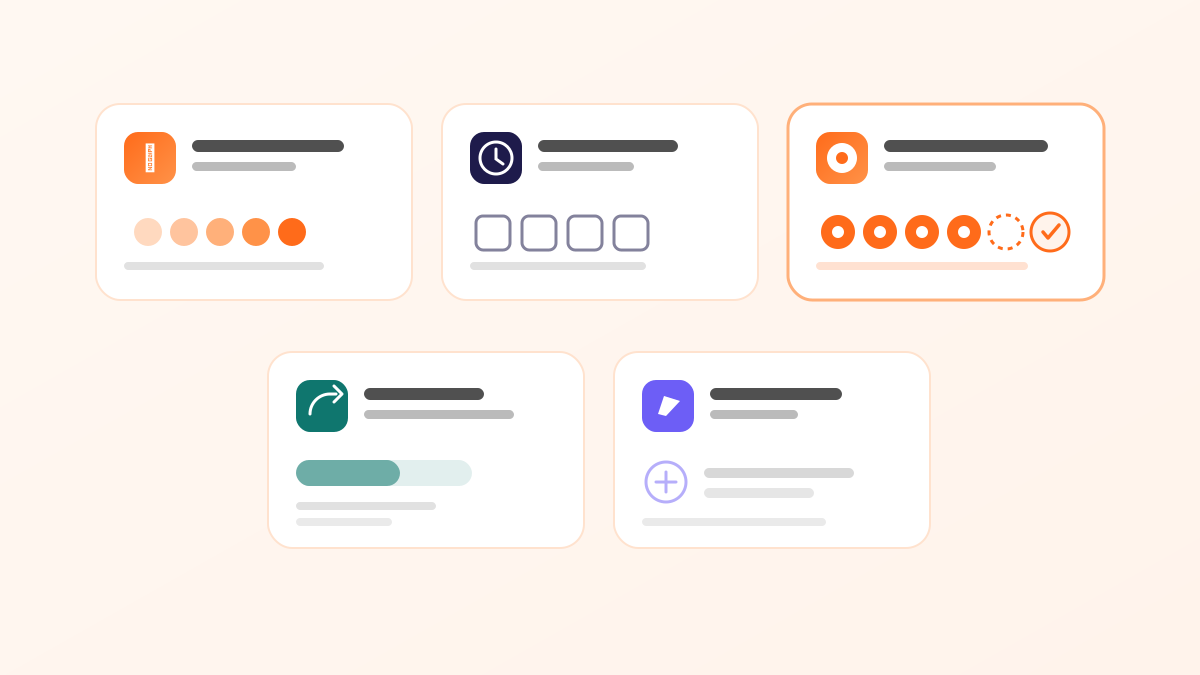
| Type | How the customer earns | What you configure | Best for |
|---|---|---|---|
| Point per riyal | Points on every riyal spent | The points-to-riyal ratio | Baskets that vary in size |
| Points per visit | A flat amount every visit | Points awarded per attendance | Building a habit of showing up |
| Buy 5, get the 6th free | One stamp per purchase | A goal from 3 to 9 stamps | One repeat product at a steady price |
| Cashback | A percentage returned as card balance | Rate, minimum spend and cap | Larger baskets and considered purchases |
| Manual award | Granted by staff under your rule | The whole rule | Services and edge cases |
The stamp card deserves a note of its own, because it is the one people ask for most. Niqati defaults to five stamps with the sixth free, and our advice is to leave it there: a reward within reach gets believed, a distant one gets forgotten. But the goal is yours to set — anywhere from three to nine — so if your customer's cycle is long (a barber seen every three weeks, say), three or four beats nine by a wide margin. Everything that goes into getting that decision right — the cycle-length rule, the design, and how to leave paper behind — is on our digital stamp cards page.
Quick test: take the typical gap between two visits and multiply it by your stamp count. If the answer runs past three months, your card is longer than your customer's patience — shorten it.
Points programmes: what is a point worth in riyals?
A points programme sounds more complicated than it is. You need two numbers: how many points a customer earns per riyal, and how many points buy what reward. Divide the second by the first and you have your give-back rate — the only figure your budget actually cares about.
| Setup | On a 100 SAR bill | Reward threshold | What you really gave back |
|---|---|---|---|
| 1 point per riyal · 500 points = 25 SAR | 100 points | After 500 SAR spent | 5% of spend |
| 1 point per riyal · 400 points = 20 SAR | 100 points | After 400 SAR spent | 5% of spend |
| 2 points per riyal · 500 points = 15 SAR | 200 points | After 250 SAR spent | 6% of spend |
| 1 point per riyal · 1000 points = 30 SAR | 100 points | After 1000 SAR spent | 3% of spend |
The third row shows a useful trick. Doubling the earn rate makes the programme feel dramatically more generous while your cost moves by a single percentage point, because the threshold moved with it. Your customer reads "two points per riyal" and feels the difference; your budget reads 6% instead of 5%.
Stamp cards make the same arithmetic blunter. "Buy five, get the sixth free" reads to a customer as a 20% discount, while costing you the goods on one item in every six you sell — roughly 6% of member revenue at typical margins. That gap between what is felt and what is spent is the whole beauty of loyalty programmes, and also why they fail when nobody does the sums before launch.
Build a card, set the rate and the threshold, and see how it looks in the wallet before you announce anything.
Start freeA loyalty app: what does a merchant actually need?
When an owner starts looking for a loyalty app, they usually mean one of two very different things, and conflating them gets expensive: do they want software their customers install, or a tool they and their staff operate?
The first is a trap for most businesses. An app your customers install means persuading each one to visit a store, download, and register before earning a single point — and you pay that toll on every new customer, forever. A pass in the wallet removes the barrier entirely: your customer installs nothing, because the wallet was on their phone before they had heard of you.
The second is what you genuinely need, and that is the merchant app in Niqati. Five jobs cover it:
- Scanning at the till. Staff open the scanner and read the pass; the stamp or the points land immediately, and the customer sees the new balance before the order reaches them.
- A profile per customer. Balance, visit history, redemptions — everything you need to tell an actual regular from someone who came once and vanished.
- Notifications. A message to your customer's lock screen when their reward is ready or an offer opens. The channel is as powerful as it is easy to ruin, so spend it carefully.
- Staff permissions. Each employee with their own account and rights, and a log showing who awarded how much and when. This is what turns a programme from personal trust into a system.
- Analytics. Sign-ups, scans, redemptions and repeat rate, per branch. Without that screen you cannot tell whether the programme is working or just giving things away.
The practical summary: one app on your team's phones, zero apps on your customers'. For a screen-by-screen walkthrough of the dashboard, the user guide takes it step by step.
Choosing a platform: five criteria that actually matter
Most comparisons online list features. Features rarely separate one platform from another; five things do, and all of them show up two months after launch rather than before:
- Does it support both wallets? The Saudi handset market splits sharply between iPhone and Android, and supporting only one quietly excludes a large slice of your regulars. The specifics live on Apple Wallet loyalty cards and Google Wallet loyalty cards.
- Is Arabic native or translated? Broken Arabic letterforms on a card that asks for loyalty read as carelessness. Ask to see a real Arabic pass before you pay for anything.
- Is the price published? A price hidden behind "contact us" usually means it changes depending on who is asking. Ours is published in riyals on the page.
- Do you own your data? Ask directly: can I export my member list, and is there an API? A platform that says no is holding your customers, not serving them.
- Does it grow with your branches? Two locations today can be six in a year. Branches, permissions and integrations need to exist before you need them.
If you are at an earlier stage — still deciding whether you need a scheme at all, which mechanic suits your market, and how to build the economics from scratch — start with our guide to the customer loyalty program. And if your real problem is leakage rather than launching a card, customer retention is closer to the question you are asking.
Loyalty cards for cafés, restaurants and salons
Same platform, very different settings. These are the starting points we see work most often by sector:
| Business | Suggested setup | Why |
|---|---|---|
| Cafés | Stamps, goal of 5 | The drink repeats at a steady price, and visible progress builds the habit |
| Restaurants | Point per riyal | Bills swing between a solo lunch and a family table |
| Salons and barbers | Stamps, goal of 3 or 4 | The visit cycle runs in weeks, so a short card stays within reach |
| Retail | Points or cashback | Purchases are considered, and cashback persuades the calculating shopper |
| Car washes | Stamps, goal of 5 | A single-price service repeating on a monthly rhythm |
| Gyms | Points per visit | Attendance itself is the behaviour you want, not spend |
Each sector has detail a table cannot hold. We have written standalone guides with SAR math for all of them: the best loyalty program for cafés, plus versions for restaurants, salons, retail stores, barbershops and gyms. Where the table says cashback, the rate, minimum and cap behind it are worked out in full on our cashback loyalty program page. And if you are still choosing a platform rather than a mechanic, we compare the five approaches on the best loyalty program in Saudi Arabia.
And if you would rather see the finished article before building anything, our customer cards gallery shows real passes from Saudi businesses running today — cafés, salons, restaurants and clinics. It is the fastest way to picture your own brand inside the wallet.
What do loyalty cards cost in Saudi Arabia?
A question the market rarely answers plainly, because most platforms hide the number. Ours is here in full:
| Plan | Price | What you get |
|---|---|---|
| Free | 0 SAR, forever | One loyalty card, up to 50 customers, Apple Wallet and Google Wallet, QR scanner, visit and point tracking |
| Pro | 49.99 SAR / month or 499.99 SAR / year | Unlimited cards and customers, notification system, detailed analytics, custom card design, fast support |
| Enterprise | Custom pricing | Everything in Pro, plus a public REST API, webhooks, POS integrations, branch and team management, and an SLA |
The free plan is not a timed trial — it is a permanent tier capped at fifty customers, which is plenty to test the idea on your regulars before spending a riyal. Most people who move to Pro do so for one of two reasons: they outgrew the customer cap, or they wanted notifications after watching members accumulate with no way to reach them. Full detail and comparison sit on the pricing page.
How to launch loyalty cards in a single day
The technical part is faster than most owners expect. The human part — briefing the team — is what decides the outcome:
- Design the card. Your logo and brand colours, and the card name in Arabic and English. Then pick a mechanic from the five types based on your customer's buying cycle.
- Set the earn rule and the reward. Two numbers, no more. Keep the first threshold close enough that a customer reaches it in weeks rather than months.
- Print the QR code, and nothing else. A stand at the till, a code on the receipt, a sticker on delivery bags, a link in your Instagram bio. That is the entire print run for the whole programme.
- Add the card to your own phone first. Scan, join, send yourself a test stamp, redeem a dummy reward. Any friction you hit here, a hundred customers will hit after you.
- Drill the team on one sentence. "Scan the code and you'll collect points — the card goes straight into your wallet." That line at the till matters more than every design decision combined, because it is the one said three hundred times a day.
- Go live and watch week one. Daily sign-ups are your first signal; if the number is low, the problem is where the QR sits or how the till phrases it — not the programme.
Then be a little patient. Sign-ups start on day one because joining is free and instant, but a move in repeat rate needs sixty to ninety days for a meaningful share of your customers to complete a buying cycle.
Privacy, branches and integrations
Three questions that usually arrive late and are better settled early:
- Privacy. Niqati is built so your data and your customers' data are protected. Joining requests no device permissions and no access to contacts, and what you see as a merchant is what the programme generates: visits, balances, redemptions, and whatever the customer volunteered. Storage and protection details are on the security page.
- Branches. The card follows the customer, not the location: earn anywhere, redeem anywhere, while you get per-branch performance with separate permissions and an activity log per employee. Full explanation in the branches guide.
- Integrations. If you run a POS or an online store and want points awarded automatically on every sale, the Enterprise plan opens a public REST API, signed webhooks and idempotent operations. Start at API access.
Frequently asked questions
What are loyalty cards?
Cards you issue to customers to record what they buy and reward them for it — stamps, points or cashback — now stored in the phone's wallet instead of on paper, updating automatically with every purchase.
Does my customer have to install an app?
No. The pass goes into Apple Wallet or Google Wallet, already on their phone. The only app involved is the merchant app your team uses.
How much do loyalty cards cost in Saudi Arabia?
From zero: a permanent free plan with one card and up to 50 customers, then Pro at 49.99 SAR monthly or 499.99 SAR yearly, then Enterprise at custom pricing.
Points or stamps — which should I choose?
Let basket size decide. Similar tickets (café, car wash, barber) suit stamps for the clarity of progress; varying tickets (restaurant, retail, clinic) suit points because they reward spend.
How many stamps should a stamp card have?
Five with the sixth free is the default and the recommendation for most businesses. The goal is yours to set from 3 to 9 — the longer the gap between visits, the shorter the card.
Do loyalty cards work across multiple branches?
Yes. The card follows the customer rather than the location, with separate performance reporting, permissions and an activity log per branch.
What if I change the design or reward later?
Edits reach every issued card immediately. No reprint, and no period where two versions of the card are in circulation.
Is customer data protected?
Yes, Niqati is built for it. Joining needs no device permissions, and your data is limited to what the programme generates and what the customer shared willingly.
How soon will I see a change in repeat visits?
Sign-ups from day one; a measurable shift in repeat rate usually needs 60 to 90 days for enough customers to complete a full buying cycle.
Written by the Niqati team from running Apple Wallet and Google Wallet passes for Saudi merchants. Last reviewed . Prices shown are Niqati's published rates; any margin arithmetic is illustrative — rebuild it with your own numbers before launch.