

Why restaurant loyalty plays by different rules
Three facts separate restaurants from every other loyalty context, and a good program is designed around all three.
Checks vary wildly. The same customer might spend 28 SAR on a workday shawarma and 350 SAR hosting Friday dinner. A visit-based stamp treats those identically; a points system doesn't. This is why points per riyal is the default mechanic for restaurants — it keeps the program fair at both ends of the check spectrum.
One person pays for many. Saudi dining runs on hospitality: the host picks the place and picks up the bill. That concentrates loyalty value exactly where you want it — on the decision-maker. A points program quietly turns your most generous hosts into your most invested members, because their 300-SAR evenings build balances fast.
Frequency is lower, stakes are higher. A regular diner might visit two to six times a month, not twenty-two like a coffee drinker. Fewer touchpoints mean each one has to count — and the program's reward ladder has to respect the slower rhythm, or the first reward drifts months away and the program dies quietly. (The general framework across all industries lives in our complete loyalty guide; what follows is the restaurant-specific application.)
Which program type fits your restaurant format?
| Format | Typical check | Best mechanic | Why |
|---|---|---|---|
| QSR / single-dish concept (shawarma, burgers, broasted) | 15–35 SAR | Stamps — buy 5, 6th free | Orders are near-uniform; speed at the till rules |
| Casual dining | 45–80 SAR | Points per riyal | Variable checks need proportional rewards |
| Family / large-format | 100–250 SAR | Points + a generous ladder | Hosts build big balances; reward the decision-maker |
| Premium / fine dining | 250+ SAR | Points, experience rewards | Chef's table beats a discount at this level |
Notice what's absent: percentage-off discounts as a program. A discount reduces today's bill and creates no tomorrow; points defer the same generosity to a future visit that must actually happen. Same cost, opposite behavior.
Designing points from your average check
Points systems fail in one of two ways: the reward is so far away nobody chases it, or so rich it eats the margin. Both are avoidable with twenty minutes of arithmetic. Use this three-step recipe:
- Anchor on your average check. Pull a month of receipts. Say it's 60 SAR at a casual-dining spot.
- Decide the give-back. 7–9% of member spending in menu value is a healthy band for restaurants — noticeable to the member, and because rewards are your own food at ingredient cost (typically 30–35% of menu price), the true cost lands near 2.5–3% of member revenue.
- Build a two-rung ladder. The mistake is a single distant summit. Instead: a first reward reachable in ~5 visits, and a headline reward for the committed.
Worked out at 1 point per riyal on the 60-SAR check:
| Rung | Points needed | ≈ Visits | Reward (menu value) | Give-back |
|---|---|---|---|---|
| First taste | 300 | 5 | Dessert or appetizer (~25 SAR) | 8.3% |
| Headline | 750 | 12–13 | Full meal (~60 SAR) | 8% |
The first rung exists to prove the program is real — members who redeem once present the card forever after. The headline rung gives your heavy hosts something worth talking about at the table. Both rungs cost you roughly a third of their menu value in ingredients, which is what keeps the whole structure comfortably under 3% of member revenue.
Family-restaurant variant: at a 120-SAR average check, the same ladder becomes 600 points (5 visits) for a 50-SAR family appetizer platter and 1,500 points for a 120-SAR meal — identical percentages, doubled absolute numbers. The recipe scales with the check; the visit counts stay constant.
The delivery-app trap — and loyalty as the exit
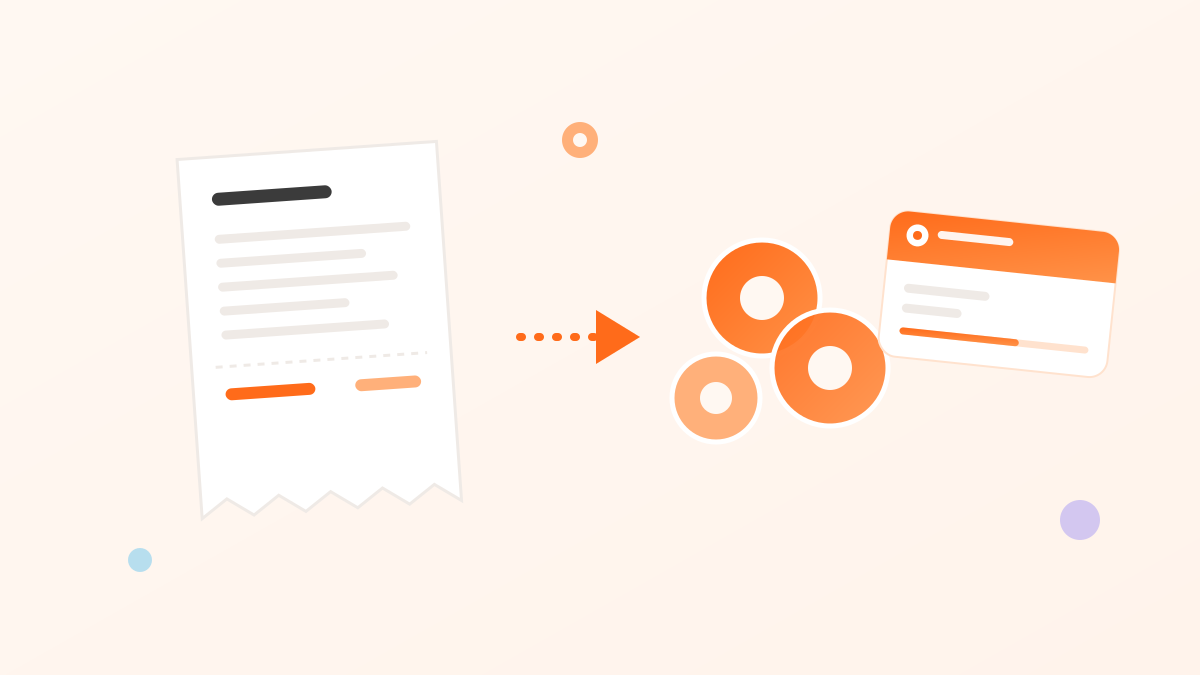
Delivery platforms solved your reach problem and created a dependency problem. Commissions commonly run between 15% and 30% of the order, the customer relationship lives inside the platform's app, and the reorder button shows your competitors first. You don't have customers there; the platform has customers who sometimes choose you.
A loyalty program is the most practical counterweight an independent restaurant has, because it creates a reason to order directly that platforms can't replicate: points only you can grant. The playbook:
- Seed from the bag. Every delivery order — platform or direct — carries a card in the bag: "Your next order earns points. Scan, add to wallet, done." The platform delivered your recruiting material for you.
- Reward the direct path. Points accrue on pickup and dine-in scans. The platform customer who joined from the bag now has a running balance that only grows when they come to you directly — a standing, personal argument against the 25%-commission route.
- Do the math on one conversion. A household ordering 200 SAR a month through a platform at 25% commission costs you 600 SAR a year in fees. Convert them to direct and the entire loyalty program's give-back on that household (~8% perceived, ~3% true cost) is a fraction of the commission you stopped paying. Loyalty isn't a cost center here — it's commission arbitrage.
When stamps beat points at a restaurant
If your menu is really one product in three sizes — the shawarma shop, the burger joint, the broasted house — the café logic applies, not the fine-dining logic: orders are uniform, the queue is long, and comprehension speed wins. Run the stamp card: buy 5 meals, the 6th free. At a 25-SAR combo with roughly 8–9 SAR of ingredients, the free sixth meal costs about 7% of member revenue — richer than points give-backs, but visit-based programs earn it back in pure frequency, and the one-sentence rule survives the lunch rush intact. The café guide's short-card argument applies verbatim: the faster the first free meal arrives, the more of your sign-ups become regulars.
Rolling it out inside the service flow
Restaurants have something cafés don't: minutes of seated attention. Use the service flow's natural pauses:
- On the table: a small tent card with the QR and the one-line rule, positioned where the menu decision happens.
- With the bill: the highest-converting moment. The check presenter carries the QR and the line "هالفاتورة كانت تجمع لك نقاط" — this bill could have been earning you points. Regret is a sign-up engine.
- At payment: staff scan the member's wallet card as the payment happens — one gesture, both cards, done. No POS surgery required.
- In every delivery bag: the conversion card from the section above.
- The staff line: one sentence, agreed and rehearsed: "Are you collecting points with us?" — asked exactly once per table, at the bill.
Real branded wallet cards from Saudi restaurants on Niqati — steal the good design decisions.
Browse customer cardsWhat to measure (and what to ignore)
- Member share of revenue. The north star: what portion of monthly revenue is attached to a scanned card? Growth here means the program is becoming the business, not a gimmick beside it.
- 60-day return rate, members vs non-members. Restaurants breathe slower than cafés — use a 60-day window. The gap between the two groups is your program's measurable effect.
- Ladder progress. How many members sit past the first rung? A pile-up below rung one means the first reward is too far; move it closer.
- Bag-card conversions. Members whose first scan followed a delivery order — the direct measure of the anti-commission play.
- Ignore: total points issued. It grows automatically and flatters everyone. Points redeemed and visits returned are the truth.
A proper dashboard hands you all of these without spreadsheet work — that's the job of the analytics side of the platform, not your Sunday evening.
Restaurants are often sold loyalty as part of a point-of-sale contract, which is not always the cheapest route to it. Our comparison of the best loyalty program in Saudi Arabia prices that option honestly against the alternatives.
Frequently asked questions
Should restaurant loyalty points expire?
For independents, generosity beats urgency. Expiry creates angry conversations at the till and teaches members the program can take back what they earned. Want urgency? Run limited-time bonus campaigns instead — urgency in the earning, never in the taking.
The host pays for the whole table — do they get all the points?
Yes, and it's the right design. The host who covers the 300-SAR family bill is the decision-maker you most want returning. Points concentrating on the payer aim the program's whole force at the person who chooses the restaurant.
Can delivery customers join the program?
Yes — via the card in every delivery bag. They add your wallet card at home and start earning on their next pickup or dine-in visit. That's the platform-to-direct conversion machine working order by order.
Are points better than straight discounts?
Almost always. A discount lowers today's bill and buys nothing tomorrow. Points cost similar margin, pay out in your own food at ingredient cost, and only reward customers who actually returned. Same generosity, opposite behavior.
What repeat rate should I expect?
Industry observation says most first-time diners never return — often around two in three. Baseline your own 60-day return rate first, then judge the program by how far it moves that number over a quarter, especially for members versus non-members.
Published · Last updated · Costs, checks and commissions are illustrative ranges — rebuild the tables with your own numbers.