
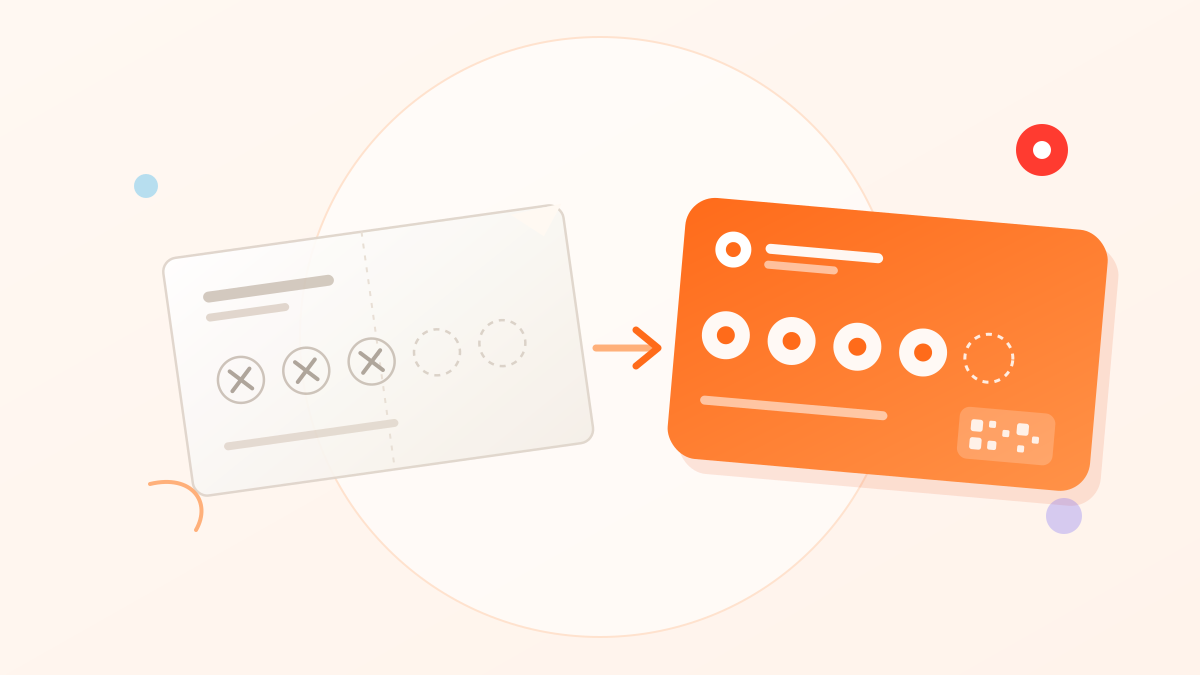
What a digital stamp card is
A digital stamp card is the same bargain the paper one offers — buy a set number of something, get the next one free — held on a pass inside the customer's phone instead of in their pocket. They scan a QR code once at the counter and the card arrives in Apple Wallet or Google Wallet in a few seconds. After that, every qualifying purchase adds a stamp and the card redraws itself.
The mechanic is deliberately unchanged, and that is the point. Your customers already understand it; nobody needs to be taught what four filled circles and one empty one means. What changes is everything around the mechanic: the card cannot be lost, cannot be completed with a borrowed pen, works at every branch you own, and leaves you with a list of people you can actually reach.
It is worth being precise about the terminology, because the same object goes by several names. A punch card, a stamp card, a coffee card, a كرت تختيم — these are all the same thing, and the digital version replaces all of them. What it is not is a points programme: there is no exchange rate to learn and no balance to interpret, only a count and a goal.
The four ways paper punch cards fail
Paper is not a bad idea badly executed; it is a good idea whose medium leaks at four separate points. Each leak is worth naming, because each one is a number you are currently losing without seeing it.
| Failure | What it costs you | How the digital card closes it |
|---|---|---|
| It gets lost | Every loss resets a customer to zero and removes the reason they were returning | The pass sits in the wallet they use to pay; losing it means losing the phone |
| It is forgeable | A similar pen completes a card nobody earned — an invisible, unbounded cost | Stamps are added only by an authenticated member of your staff, and logged |
| It is single-site | A chain ends up running several disconnected schemes | The card follows the customer; earn at one branch, redeem at another |
| It is anonymous | You learn nothing you can act on and have no way to reach anyone | Visit history, redemption data, and a notification channel you own |
The forgery point deserves a moment, because owners consistently underestimate it. A paper punch card is secured by a rubber stamp that costs about twenty riyals to reproduce and a pen that costs three. Nobody is running an organised operation against your café, but a handful of customers marking their own cards is common, and you have no way of even estimating the number. The digital version does not so much solve the problem as delete the category.
The anonymity point is the expensive one, though. A completed paper card tells you a transaction happened. It does not tell you who, when they last came, or whether they have stopped coming — which means you cannot do the single most valuable thing a loyalty programme enables, which is notice a regular going quiet and give them a reason to come back.
How many stamps should the card have?
This is the question owners agonise over and usually settle by copying a competitor. Niqati defaults to five stamps with the sixth item free, and for most businesses that is genuinely the right answer — but the goal is yours to set anywhere from three to nine, and matching it to your own buying cycle is worth more than any other decision on this page.
The rule is about time rather than count. Take the typical gap between two visits and multiply it by the number of stamps:
| Business | Typical gap | Sensible goal | Time to reward |
|---|---|---|---|
| Café, daily commuter | 2 days | 5 or 6 | Under two weeks |
| Restaurant | 2 weeks | 4 | Around two months |
| Car wash | 2 weeks | 5 | Around ten weeks |
| Barber | 3 weeks | 3 or 4 | Two to three months |
| Salon, colour service | 6 weeks | 3 | Around four months |
The three-month line. If your goal puts the reward more than about three months away, shorten the card. A reward within sight gets believed and chased; a distant one gets forgotten, and a forgotten card is worse than no card because you paid for the stamps that led nowhere.
The instinct to set a high goal is understandable and almost always wrong. Nine stamps looks cheaper on a spreadsheet, but a card most customers never finish generates no repeat visits and no goodwill — you have merely given away eight small discounts in exchange for nothing. A short card that people actually complete is cheaper per unit of behaviour changed, which is the only measure that matters.
What "buy five, get the sixth free" really costs
Your customer reads that offer as a 20% discount, because one item in every six arrives free. Your accounts see something quite different, and the gap between the two is the entire reason this mechanic has survived a century.
You give away goods, not revenue. On an 18 SAR latte that costs roughly 4.50 SAR in beans, milk and cup, the free sixth coffee costs you 4.50 SAR — against the 90 SAR of revenue the preceding five generated. That is about 5%, for something the customer values at 18.
That ratio holds well for food and drink, where margins are high. It holds much less well elsewhere, and this is where stamp cards get businesses into trouble. If you sell a product at 25% margin, the free item costs you 75% of its price, and a buy-five card is giving away roughly 15% of member revenue rather than 5%. On thin margins, either lengthen the card or reward with something cheaper than the headline product — an add-on, a service, an upgrade — rather than the product itself.
One further refinement worth making: set the reward to something with a high perceived value and a low cost to you. A free coffee alongside a purchase, a free interior vacuum with a wash, a free beard trim with a cut. The customer counts the menu price; you count the goods.
Choose a goal from three to nine, design the card, and scan it onto your own phone before you print a single QR.
Start freeDesigning the card
A stamp card is looked at more often than almost anything else you produce, because the customer opens it to check their progress. It is worth more than five minutes.
Niqati's stamp designer lets you control the card's colours, your logo and the stamp icon itself — the mark that fills each slot as it is earned. Choosing an icon that matches what you sell does more work than it sounds like: a cup for a café, a car for a wash, a pair of scissors for a barber. It turns an abstract counter into a picture of the thing the customer is collecting.
Three practical notes from cards that work:
- Contrast beats brand purity. An earned stamp and an empty slot must be distinguishable at a glance, on a phone, in sunlight. If your brand colours are two similar mid-tones, use a lighter and darker version rather than insisting on both.
- Say what earns a stamp on the card itself. "One stamp per drink" prevents the most common counter argument, which is a customer who bought a pastry expecting a stamp.
- Put the reward in words, not just circles. "Your 6th coffee is on us" is understood instantly; six empty circles alone are not.
Because the card is a wallet pass rather than a printed object, redesigning it costs nothing and reaches everyone. Change the artwork and every issued card updates in place — no reprint, and no period where two versions of your card are circulating. More on how the two wallet formats differ is on our digital loyalty cards page.
Multiple stamps per visit, and letting rewards accumulate
Two settings separate a stamp card that survives real trading from one that quietly irritates your best customers.
Multiple stamps in one visit. Someone buys four coffees for their colleagues. On paper they get one stamp, because the card assumes one visit equals one purchase. That is precisely backwards: the customer spending the most is rewarded the least. Staff can add several stamps at once using the stepper above the add-stamp button, so a bulk purchase earns what it actually bought. This matters most for offices ordering rounds, families paying on one bill, and car washes selling a pair of washes together.
Accumulating rewards. By default, a card that reaches its goal is holding a reward and waits to be redeemed. If your customer is a daily regular, they may well hit the goal again before they get round to claiming the first one. Allowing rewards to accumulate banks the completed reward and lets the card carry on collecting immediately, so someone can hold two or three free items and use them when it suits them.
Turn accumulation on if your cycle is short. For a café with daily regulars it prevents the most frequent buyers from hitting a ceiling. For a salon seen every six weeks it changes almost nothing — the customer will always redeem long before they earn again.
Both settings live on the card, so you can run them differently on different cards. Every stamp added is recorded against the employee who added it, which makes the activity log the answer to the question paper could never settle: who gave away what, and when. Permissions are set per person, so a cashier can add stamps and redeem rewards without touching card settings — the detail is in managing employees.
Cafés, barbers and car washes
Stamps are not a general-purpose mechanic. They are excellent in a specific shape of business — one repeating product, a roughly steady price, and a short gap between visits — and mediocre outside it.
Cafés are the archetype and the easiest win. The product repeats daily, the price barely moves, and progress toward a free drink is a genuinely strong pull. Five or six stamps, one per drink, a cup icon; there is very little to think about. The deeper version of this argument, with menu-level numbers, is in the best loyalty program for cafés.
Barbers need a shorter card than instinct suggests. At a three-week cycle, a five-stamp card puts the free cut nearly four months out, which is past the horizon most customers will hold in their heads. Three or four works far better, and the reward can be a beard trim rather than a full cut if the margin needs protecting. See the best loyalty program for barbershops.
Car washes are the strongest case for multi-stamp visits, because customers frequently pay for two or three washes at once. They are also the clearest illustration of the paper problem: a punch card kept in the car door survives approximately one summer. The comparison is worked through in car wash punch cards versus digital.
Where stamps are the wrong tool is anywhere bills swing widely — a restaurant where one table spends 90 SAR and the next spends 600, or a retail store with a mixed basket. There, a stamp rewards showing up rather than spending, and you want either points or a cashback loyalty program instead.
Switching off paper without losing your regulars
The migration is where switches go wrong, and it goes wrong in exactly one way: a regular who has collected four stamps hears the scheme is changing and concludes their progress has been taken away. Everything below exists to prevent that single feeling.
- Announce it as an upgrade, not a replacement. "Your card now lives in your phone and can't be lost" is a benefit. "We're discontinuing the old cards" is a loss.
- Honour paper for two weeks, and say so first. Let staff carry across whatever a customer has already collected onto their new digital card. The cost is a handful of stamps; the alternative is an argument at the counter with your most loyal customers.
- Enrol at the counter, not by asking people to go home and set it up. Print the QR and put it where people already wait — beside the till, on the table, on the receipt. Joining takes about five seconds and needs no app.
- Give the counter one sentence. "Scan this and your stamps are saved to your phone — I'll move your paper ones over now." Staff who have a line to say will offer it; staff who do not will forget the programme exists.
- Keep the paper stock for a fortnight, then stop reordering. Do not make a ceremony of the ending.
Then leave it alone. Sign-ups begin on day one because joining costs the customer nothing, but a measurable shift in repeat visits usually needs sixty to ninety days — long enough for a meaningful share of your customers to complete a full cycle and for you to have a baseline worth comparing against.
What a digital stamp card costs
Less than the card stock it replaces, which is the part most owners do not expect. There is a permanently free tier — one card, up to 50 customers, no expiry date — and a single-site café can run a genuine programme on it for as long as it likes. Moving up to Pro lifts those ceilings and switches on notifications, detailed analytics and custom design, at 49.99 SAR monthly or 499.99 SAR if you pay for the year. Chains needing the public API, POS integrations or branch management sit on Enterprise, which is quoted per business.
Set that against printing. A run of a thousand paper cards costs a few hundred riyals, has to be reordered, and buys you none of the things on this page — no customer list, no notification channel, no protection against forgery, and no idea who is about to stop coming. Full plan details are on the pricing page.
Frequently asked questions
What is a digital stamp card?
The paper punch card moved into Apple Wallet or Google Wallet. One QR scan adds it, each purchase adds a stamp, and the card updates itself. Nothing is installed.
How many stamps should my card have?
Five with the sixth free is the default and suits most businesses, but you can set the goal from three to nine. Match it to your visit cycle — if the reward is more than three months away, shorten it.
What does buy five, get the sixth free cost me?
About 5% of member revenue on typical café margins, not the 20% the customer perceives, because you give away goods rather than revenue.
Can a customer earn more than one stamp per visit?
Yes — staff use the stepper above the add-stamp button, so a bulk purchase earns what it actually bought rather than a single stamp.
What if a customer reaches the goal twice before redeeming?
With reward accumulation on, completed rewards are banked and the card keeps collecting, so a frequent buyer never hits a ceiling.
How do I stop staff giving away free stamps?
Every stamp is logged against the employee and timestamped, and permissions are per person — a cashier can add and redeem without reaching settings.
Do stamp cards work across branches?
Yes. The card belongs to the customer, so stamps earned at one branch redeem at another, while reporting stays separate per branch.
Should I honour paper cards during the switch?
Yes, for about two weeks, and announce it before anyone asks. Carrying stamps across costs little and removes the only real objection to switching.
Are stamps better than points?
Where one product repeats at a steady price, yes — progress is visible and needs no explanation. Where baskets vary widely, points are fairer.
Written by the Niqati team from running Apple Wallet and Google Wallet passes for Saudi merchants. Last reviewed . Prices shown are Niqati's published rates; all margin arithmetic is illustrative — rebuild it with your own numbers before launch.